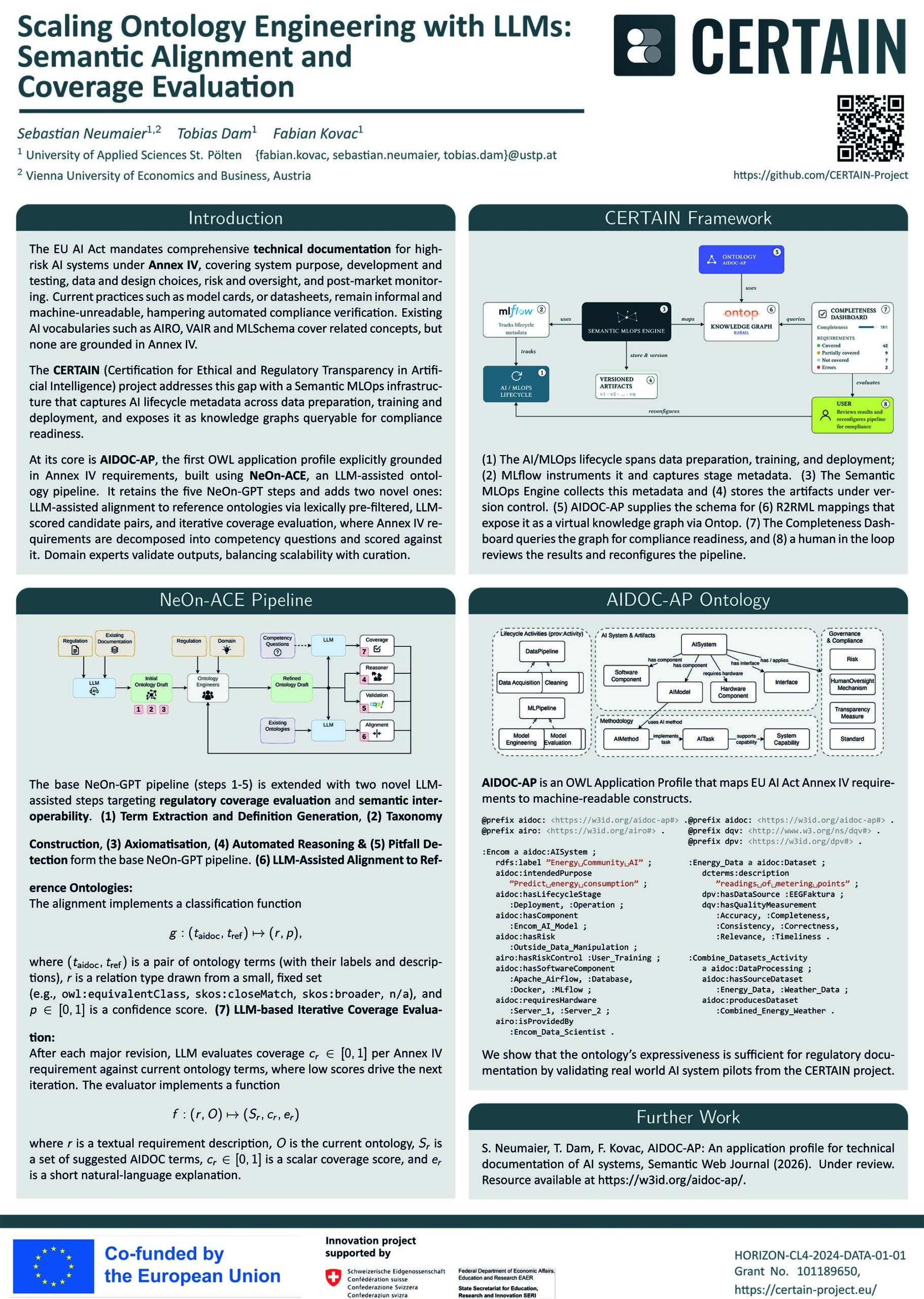
The CERTAIN project was present at SEMANTiCS 2026, the 22nd International Conference on Semantic Systems, which took place from September 15th to 17th at the Music Center de Bijloke in Ghent, Belgium. SEMANTiCS is one of Europe’s most established venues for semantic technologies, bringing together researchers, industry practitioners, and public sector representatives working on knowledge graphs, ontologies, linked data, and, increasingly, the intersection of semantic systems and large language models. For CERTAIN, whose approach to AI compliance is built on exactly this intersection, it was a natural stage to present our latest methodological work.
CERTAIN in the Posters & Demos Track
CERTAIN contributed the peer-reviewed paper “Scaling Ontology Engineering with LLMs: Semantic Alignment and Coverage Evaluation”, authored by Sebastian Neumaier, Tobias Dam, and Fabian Kovac from the University of Applied Sciences St. Pölten, accepted in the Posters, Demos, Blue Sky, and Tutorials track of the conference and presented as a poster during the session. The paper introduces NeOn-ACE (Alignment and Coverage Evaluation), an extension of the NeOn-GPT pipeline that integrates LLMs into ontology engineering for regulation-driven application profiles. While the EU AI Act serves as the motivating example, the methodology itself is designed for regulatory texts in general.
NeOn-ACE retains the five established NeOn-GPT steps (terminology extraction and definition generation, taxonomy construction, axiomatisation, automated reasoning, and pitfall detection), tailors them to regulatory source texts and competency questions, and adds two novel LLM-assisted steps:
- LLM-assisted semantic alignment to reference ontologies, where lexically pre-filtered candidate term pairs are scored by an LLM and mapped to a small, fixed set of relation types (such as owl:equivalentClass or skos:closeMatch) with an associated confidence score, and
- Iterative LLM-based coverage evaluation, where regulatory requirements are decomposed into competency questions and scored against the current ontology after each major revision, with low coverage scores driving the next engineering iteration.
Human validation is performed at explicit checkpoints throughout the workflow: ontology engineers curate the LLM-generated terms, taxonomies, and axioms, and domain experts review reasoner inferences, pitfall reports, suggested alignments, and coverage scores before changes are incorporated into the next ontology revision. This balances the scalability of LLM automation with the curation that regulatory contexts demand.
From Legal Text to Machine-Readable Compliance
The methodology was demonstrated using the EU AI Act Annex IV as an example regulatory context. Annex IV mandates comprehensive technical documentation for high-risk AI systems, covering system purpose, development and testing, data and design choices, risk and oversight, and post-market monitoring. Current practices such as model cards and datasheets remain largely unstructured and machine-unreadable, and while existing AI vocabularies like AIRO, VAIR, and MLSchema cover related concepts, none are grounded in Annex IV.
This is the gap that AIDOC-AP, the first OWL application profile explicitly grounded in Annex IV requirements, was built with NeOn-ACE to close. Embedded in CERTAIN’s Semantic MLOps infrastructure, AIDOC-AP supplies the schema for exposing AI lifecycle metadata (captured via MLflow across data preparation, training, and deployment) as virtual knowledge graphs that can be queried for compliance readiness. The methodology is currently being applied and validated within CERTAIN, where the ontology and a supporting knowledge graph are populated with data from the project’s real-world pilot use cases. The prototypical implementation, including the alignment mappings and the results of the LLM-based coverage analysis, is publicly available at https://w3id.org/aidoc-ap/.
Looking Ahead
The methodology and tooling presented in Ghent are a key building block of CERTAIN’s broader vision: a Semantic MLOps infrastructure where compliance evidence is generated as a by-product of everyday ML engineering rather than assembled manually after the fact. Future work includes empirical validation of the coverage indicators, automation of knowledge graph construction, and extension to additional regulatory contexts. A companion journal article, “AIDOC-AP: An application profile for technical documentation of AI systems”, is currently under review at the Semantic Web Journal.
If you are building or auditing high-risk AI systems under the EU AI Act and want to explore what LLM-assisted, ontology-driven compliance could look like for your use case, we would love to hear from you.
🔗 Ontology: https://w3id.org/aidoc-ap/
🔗 GitHub: https://github.com/CERTAIN-Project